Skip to content Skip to footer

Writers Residency

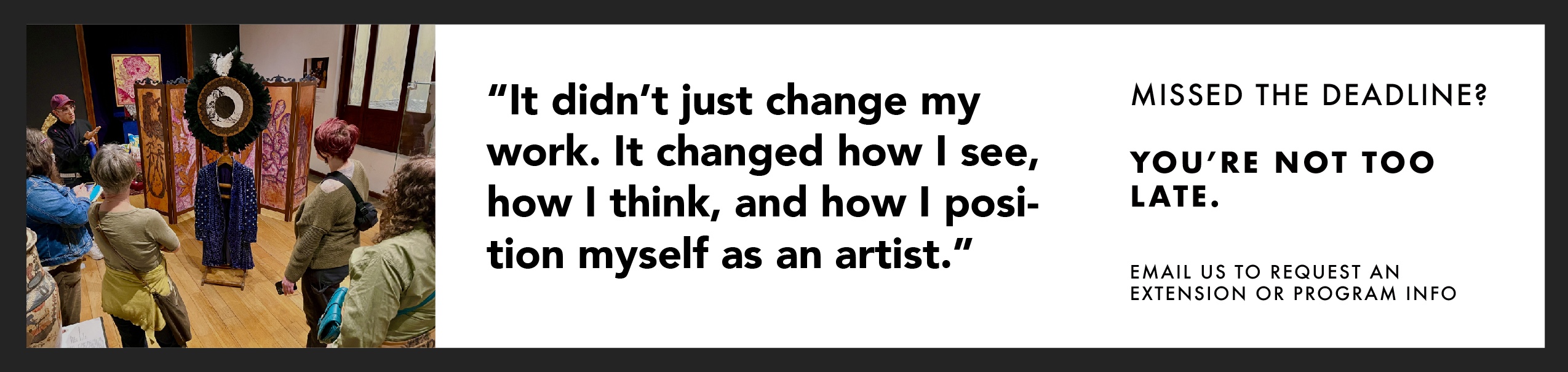
Missed the April 15 Deadline for 2026 & 2027?
E-mail Us at info@arquetopia.org
for Program Info, Application Materials, and an Extension
including Day of the Dead, and Short-Term Programs
Arquetopia Writers Residency 1aa

The Cadence of Words:
Writers Program

Locations:  Oaxaca  —  Cusco

This comprehensive, customized residency program offers competitive professional opportunities for emerging and mid-career writers, journalists, playwrights, translators, and graduate students, both national and international, age 20 and over.

Arquetopia Writers Residency 1ad
Arquetopia Writers Residency 1ab

WRITERS PROGRAM DESCRIPTION

The Writers Program is designed to offer emerging and mid-career writers, journalists, playwrights, translators, and graduate students an opportunity to engage in a comprehensive, customized creative process. This program is based on the understanding that writing, like all artistic practices, follows a rhythm—a movement that links the writer’s inner world with their community and the broader social and political landscape. The program encourages participants to explore the rhythms of their own practice, following their intuition, and how these intersect with the stories of collective histories at large. Writing is not just an individual expression but a process deeply embedded in the rhythms of culture, society, and time. Through the program’s structure, writers are invited to align their personal rhythm with a broader understanding of how history, culture, and identity shape narrative.

Building on Audre Lorde’s notion that “poetry is not a luxury,” the Writers Program frames writing as both self- expression and resistance. Lorde asserts that poetry—and, by extension, all writing—is essential for survival, providing individuals with a means to articulate their deepest truths. This concept is central to the Writers Program, where participants engage in a broader dialogue that challenges, resists, and reshapes dominant narratives. The program encourages writers to embrace their practice as a form of political action, harnessing the power of words to disrupt oppressive structures and give voice to the unspoken truths that emerge from both personal and collective experience.


Through personalized mentorship and ongoing dialogue, the Writers Program fosters a critical and reflective creative process, emphasizing Francisco Guevara’s distinction between “intention” and “intuition.” Participants are encouraged to interrogate the ideological legacies that shape their writing. Rather than adhering to rigid preconceptions or predetermined outcomes, writers are invited to embrace the fluidity of intuition, allowing their practice to evolve organically through discovery and experimentation. This self-reflective process is essential for dismantling assumptions and cultural narratives that often restrict creativity and expression. By engaging with historical and contemporary political dimensions, writers cultivate a practice that responds dynamically to the world around them, creating work that reflects their own rhythms while participating in broader global conversations. The program’s mentorship framework supports participants in deepening their craft, expanding their critical awareness, and developing a writing process that is both intellectually rigorous and intuitively driven.


In sum, the Writers Program is not just a space for honing craft but a space for reimagining the possibilities of writing. It is an invitation to join in a larger, transformative conversation about history, identity, and resistance, guided by the rhythms of both personal and collective narratives. Writers are given the tools and the space to challenge established paradigms, while developing a writing practice that is both artistically and socially engaged. It is creating something much larger than the sum of its parts: a powerful, communal force that shapes the future.

WRITERS PROGRAM METHODOLOGY

1. The Connectivity of Concepts

The Writers Program invites participants to engage with a dynamic and multifaceted approach to writing, where historical, cultural, and ideological contexts are examined in depth. Through self-reflection and personalized mentorship, participants explore how their creative practices intersect with broader social, political, and historical forces. The program emphasizes the integration of writing as both an intuitive and critical process, encouraging participants to question the ideological legacies embedded in language, storytelling, and textual production. Through ongoing dialogue and mentorship, writers develop a deeper understanding of how their work functions within global cultural conversations, challenging dominant narratives and expanding the possibilities of literary expression. By embracing intuition over rigid intention, participants are empowered to reshape their writing practice in ways that challenge traditional structures, opening space for new and transformative perspectives in contemporary literature.


2. The Practice of Unlearning
Writing has played a pivotal role in shaping contemporary notions of authorship, knowledge production, and cultural memory. The program invites participants to critically examine the ideological legacies embedded in language and written culture. This process of unlearning challenges participants to interrogate inherited structures, questioning assumptions about storytelling, language, and the authority of the written word. It fosters a deeper connection to personal and collective histories, positioning writing as a space for reimagining narratives, challenging hierarchies, and expanding possibilities for literary expression. By questioning whose stories are told, in what language, and by whom, participants dismantle conventions and resist rigid structures. Writing becomes more than an act of recording; it is a dynamic force that disrupts and reconfigures. Reclaiming language as a space of resistance, participants deepen their connection to history, expanding the boundaries of expression and redefining writing with freedom and intuition.


3. The Rhythm of Creating

In the Writers Program, rhythm becomes a space for participants to explore the interplay between form, language, and the socio-historical contexts that shape their narratives. Through the practice of writing and reading, participants come to understand rhythm not only as a stylistic device but as a means of engaging with and reshaping the structures that inform literary expression. This process fosters a dynamic relationship between creation, reflection, and critique, where writing serves as a site for both inquiry and subversion. By privileging intuition over rigid intention, participants are encouraged to reconsider the role of historical narratives in shaping contemporary voices, deepening their understanding of literary techniques, and questioning traditional literary conventions. In this environment, the evolving rhythms of writing become a space for interrogating personal and collective memory, enabling participants to navigate and redefine their artistic practice through the lens of theory, history, and experimentation.


4. The Ethics of Movement
In this program, participants engage with writing as a deeply ethical and political practice. Writing is not merely an act of self-expression but a way to confront and understand the world’s injustices. It becomes a means of resistance, a tool for questioning and reimagining the structures that shape society. The writer bears the responsibility to speak truth to power, reveal the complexities of identity, and challenge dominant narratives that perpetuate inequality. Participants are encouraged to explore the social and political dimensions of their writing, recognizing it as a space where personal and collective histories intersect. They are urged to question how seemingly neutral or “realistic” details often serve to reinforce ideological norms and power structures. By recognizing these subtleties, writers can uncover the hidden forces shaping their narratives and disrupt the illusion of objectivity. Through examining the power dynamics inherent in language and narrative, participants are empowered to use writing as a platform for resistance, to unsettle entrenched ideologies, and to contribute to the ongoing movement toward a more just and inclusive world.

Arquetopia Writers Residency 1ac
Arquetopia Writers Residency 1ae

PROGRAM DURATION / TIME PERIOD ​​

Flexible sessions of 3 to 5 weeks. Dates are not predetermined but are proposed by the applying artist.

WHAT THIS MENTORED, NON-INSTRUCTIONAL PROGRAM INCLUDES

Staff Support:

A weekly meeting with our directorial and curatorial staff for personalized mentoring, research assistance, project guidance, and critique


Accommodation and Local Transportation (Oaxaca):
• Furnished, private bedroom
24-hour access to the kitchen for participants to prepare their own meals; meals/food are the participant’s responsibility
• Wireless Internet
Use of Arquetopia’s residency common spaces
• Shared, serviced (single) bathrooms with modern fixtures and showers
• Housekeeping
• Downtown arrival pickup and departure dropoff transportation provided
• Affordable, everyday public transportation is available from the program vicinity into the city. Participants receive an orientation regarding the local transportation system upon arrival


Workspace (Oaxaca):
Personal workspace with desk or table provided


Accommodation and Airport Transportation (Cusco):
• Furnished, private bedroom
24-hour access to the kitchen for participants to prepare their own meals; meals/food are the participant’s responsibility
• Wireless Internet
Use of Arquetopia’s common spaces
• Shared, serviced (single) bathrooms with modern fixtures and showers
• Housekeeping
• Arrival pickup and departure dropoff transportation provided at Cusco Airport
• Affordable, everyday public transportation is also available from the program vicinity of Urubamba and to the city of Cusco. Participants receive an orientation regarding the local transportation system upon arrival


Workspace (Cusco):
Personal workspace with desk or table provided

PROGRAM TUITION INFO & APPLICATION DEADLINES

E-mail info@arquetopia.org for tuition info and application deadlines for this program.

TO APPLY

Click here to apply for this mentored, non-instructional program.

Arquetopia Puebla: Avenida 15 Poniente 715, Centro Histórico, Puebla, Puebla 72000 MÉXICO
Main Office Tel. (+52) 222 594 77 28 — E-mail  info@arquetopia.org
Arquetopia Oaxaca: Calle Hidalgo 706, Manzana 7 Casa 2, 1ra Sección, San Pablo Etla, Oaxaca 68258 MÉXICO
Arquetopia Peru: Fracción 2 del Predio La Granja, Sector Chichubamba, Urubamba, Cusco 08660 PERÚ
Copyright © 2009-2026 Arquetopia® Foundation. All Rights Reserved.